Scarcity Mindset: Signs, Causes, and How to Escape It
An Important Distinction
Survival mode and scarcity mindset are often confused, but they are not the same.
• Survival mode: Your body and mind act as if existence is under threat. Every decision focuses on conserving energy and protecting resources.
• Scarcity mindset: The belief that there is “never enough,” even when basic needs are met.
Although survival mode and scarcity mindset share many patterns and tendencies, the key difference is this: survival mode always includes scarcity thinking, while scarcity mindset does not always feel life threatening.
What Is Scarcity Mindset?
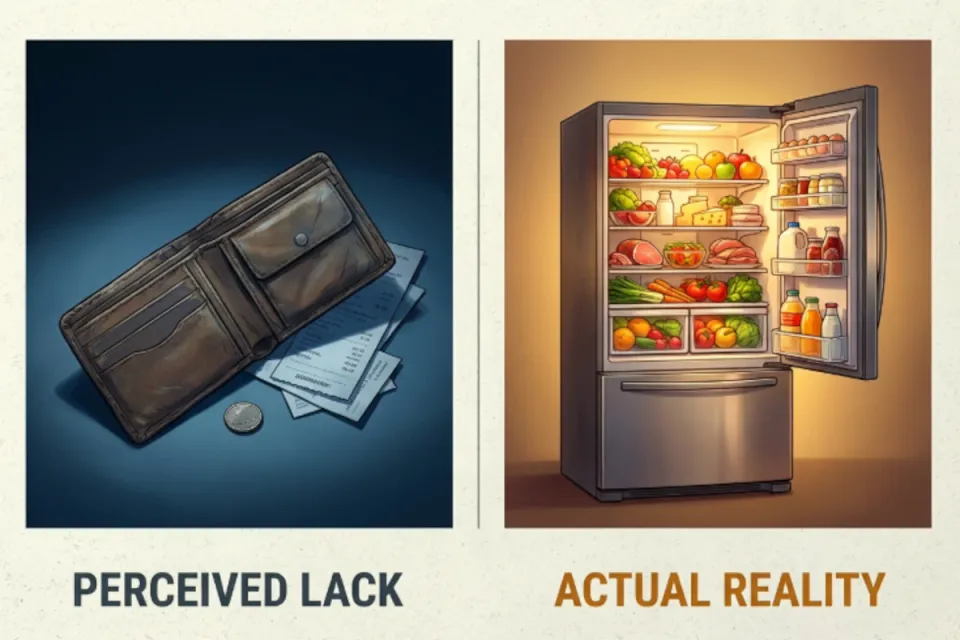
Imagine standing in front of a full fridge.
Food is there. Safety is there.
Yet your mind says: “What if tomorrow it’s empty?”
Scarcity mindset is not about actual lack. It is about perceived lack.
It makes you focus on what is missing, not what is present.
This belief shapes how you see the world:
• You worry about tomorrow instead of enjoying today.
• You compare yourself to others and feel you fall short.
• You hold back from opportunities because you fear loss.
Signs You’re Living with Scarcity Mindset
Scarcity mindset often hides in everyday thoughts and habits:
• You feel anxious about money, even when bills are paid.
• You believe opportunities are limited, so you compete instead of collaborate.
• You constantly compare yourself to others.
• You feel guilty spending on yourself.
• You neglect personal connections, prioritising work or business over relationships and leaving little time for family or friends.
• You struggle to hold onto money — it comes in and goes out just as quickly.
• You stay constantly busy, always working or on business calls, feeling you cannot afford to slow down.
• You experience emotional numbness, finding it hard to react, empathise, or even register what others are saying.
• You give surface level responses in conversations, keeping them transactional and avoiding depth or openness. “How are you? Busy.” “Do you need help? I’m fine.”
• You block learning, as even helpful advice or new ideas fail to sink in while your mind conserves energy only for urgent tasks.
These signs show that your mind is locked in a cycle of fear and limitation, keeping you focused on what’s missing instead of what’s possible.
How Scarcity Mindset Shapes Behaviour
Scarcity thinking can show up in different ways. In survival mode, the instinct is often to save everything for protection. In scarcity mindset, the more common pattern is to spend now for comfort — though in some cases, the same fear of “never enough” can also lead to extreme saving. Both extremes come from the same belief: there is not enough to feel secure.
The “Spend Now” Mentality
• Fear of loss tomorrow: “If I don’t use this money today, I might lose it.”
• Short term reward: Spending feels like comfort in uncertainty.
• Avoidance of planning: Saving feels impossible when the mind is stuck on today.
The “Save Everything” Mentality
• Fear of running out: “I must protect what little I have.”
• Extreme frugality: Holding tightly to money or possessions.
• Suspicion of sharing: Reluctance to give or invest because it feels unsafe.
Real Life Examples
At Work
• You believe promotions or recognition are rare “one time chances,” leading to aggressive competition.
• You constantly measure your salary, role, or achievements against colleagues, feeling you’re always behind.
• You avoid brainstorming or collaboration because you fear sharing will reduce your own advantage.
• You decline projects or promotions with the thought “This is too big for me,” missing growth chances.
• You refuse to spend on new tools, renovations, or technology, convinced resources must be conserved.
• You resist increasing employee pay even when productivity justifies it, fearing financial loss.
• You micromanage tasks, unwilling to delegate because you fear others might “waste” resources or outperform you.
• You insist on recognition for every small contribution, worried that others will “take” your achievements.
• You prioritise immediate cost cutting over long term growth, skipping training or innovation that could expand opportunities.
In Families
• You feel there’s never enough time to give attention, so interactions are rushed or avoided.
• You believe affection is finite, so if one child or partner receives it, others lose out.
• You over save for “what if” scenarios, even when current needs are comfortably met.
• You consistently buy the cheapest essentials, even when a slightly higher cost could bring far better quality and enjoyment.
• You store leftover cooked food for the next day, not out of practicality but from fear of waste or running out.
• You refuse to spend money on new clothes, personal care products, or perfumes, believing such purchases are indulgent.
• You skip meals to save money, even when food is available.
• You save the best food for a spouse or children, while personally settling for less, convinced that your own needs matter less.
With Money & Belongings
• You spend impulsively on sales or trends, worried you’ll miss your chance.
• You buy items to keep up with others, even when unnecessary.
• You purchase things today because you believe you might not be able to afford them tomorrow.
• You stock up excessively, not out of practicality but from fear that resources will disappear.
• You hold the deep belief that money will eventually run out, no matter how much you save.
• You frequently talk about not having enough money, reinforcing the mindset of scarcity.
• You accept inadequate food, clothing, or resources, even when more is needed, because you believe you can’t afford better.
• You say no to offers of support or generosity, convinced that accepting help is unsafe or unreliable.
Causes of Scarcity Mindset
Scarcity mindset does not appear without reason. It is triggered by:
• Financial insecurity or debt.
• Constant comparison with others.
• Past experiences of lack or poverty.
• Stress and uncertainty about the future.
• Cultural or family beliefs around money and success.
How to Move from Scarcity to Abundance
Step 1: Awareness
• Notice scarcity thoughts: “There’s not enough.”
• Replace them with: “There is enough.”
Step 2: Gratitude
• Focus on what you already have.
• Write down daily wins and blessings.
Step 3: Mindset Shift
• See opportunities instead of limitations.
• Practice abundance thinking: “Together we can create more.”
Step 4: Connection
• Share time, energy, and support.
• Generosity breaks the grip of scarcity.
Step 5: Action
• Take small steps toward a bigger goal.
• Celebrate small wins, knowing they compound into something significant over time.
Step 6: Trust in Enough
• Believe that resources, opportunities, and support will continue to flow.
• Trust that life provides what is needed, even if the path isn’t always clear.
Conclusion: From Scarcity to Abundance
Scarcity mindset whispers “never enough.”
It keeps you trapped in fear, even when your needs are met.
But abundance mindset says: “There is enough, and together we can create more.”
Escaping scarcity is not just about changing thoughts — it’s about living differently.
• You begin with awareness, noticing the limiting beliefs.
• You practice gratitude, focusing on what you already have.
• You shift your mindset, seeing opportunities instead of limitations.
• You build connection, sharing time, energy, and support.
• You take action, making small steps that compound into big wins.
• And finally, you trust in enough, believing that resources, opportunities, and support will continue to flow.
Abundance grows not only from gratitude and belief, but from the steps you take each day and the trust that life provides what is needed.
You move from guarding to sharing, from fear to trust, from limitation to growth.
Abundance is not a distant dream — it is built step by step, choice by choice.





Member discussion