Loneliness in a Relationship — A Guide Back to Each Other
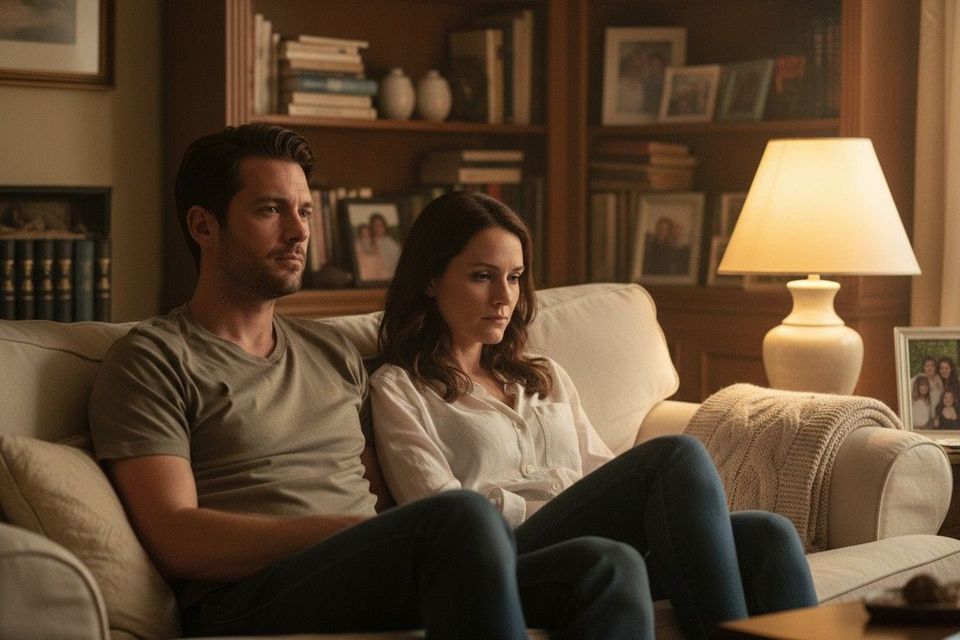
Feeling alone is hardest when someone is right there beside you.
Imagine you have just discovered a film. It is called Our First Anniversary, and from the very first scene you are captivated. The dialogue is sharp and warm and funny. The cinematography is rich — full of colour, full of light. There is something about it that makes you feel alive just watching it, and you think, with a sense of gratitude: how lucky I am to have found this.
You settle in. You sink yourself into the couch, into that rare and wonderful feeling of being completely held by something. You give it your whole attention. You are completely, happily absorbed.
And then — a glitch.
Without warning, the image flickers. The colour drains from the screen. The dialogue disappears. What was vivid and warm and full of sound is suddenly silent, suddenly black and white, suddenly still. You look around, confused.
Have I touched a cable? You check. Everything seems to be in place. You look back at the screen, waiting. These things happen. It is probably just a bad upload, a temporary interruption. It will come back.
But it doesn't come back.
The film continues — the story is there, the characters still moving through their lives — but the colour is gone, and the sound is gone, and the particular quality that made it extraordinary is gone, and you are left sitting in the dark watching something that is, in every technical sense, still a film, but no longer feels like the one you chose.
You stay. Because you have invested in it. Because it was so good, once. Because surely, any moment now, it will find its way back to what it was. And because you don't quite know what you would do if it didn't.
If you have ever felt that way — not about a film, but about your relationship — then you already understand more about relational loneliness than most people will ever put into words. And this guide is for you.
You are in the same room as your partner. Maybe you are at the kitchen table after dinner, the plates still there, neither of you moving to clear them. Maybe you are in bed, side by side, your phone in your hand and theirs in theirs. To anyone looking in, this is a life shared. Two people, together.
But there is a silence between you that has nothing to do with comfort. Not the easy quiet of two people who simply don't need to fill the air — but something heavier than that. The kind that has been there so long you have almost stopped noticing it. Except that tonight, for some reason, you notice it very much.
Two people, a few metres apart. Invisible to each other.
You might have tried to say something. Something real — not logistics, not whose turn it is to do the dishes. Something about how you are feeling, or something you read that moved you, or just — something. And your partner replied, or half-replied, and then the moment passed, and you were alone again, except that you were still sitting right there beside them.
And you thought, quietly, almost unable to part with the thought: what is happening to us? Or perhaps even deeper thoughts kept coming: has it always been like this? Since the day we met?
What is relational loneliness?
We have a clear picture of what loneliness is supposed to look like. It looks like an empty flat. It looks like eating alone. It looks like a phone that doesn't ring. That kind of loneliness is painful, but at least it makes sense — you are alone, therefore you are lonely. The cause and the feeling match.
Relational loneliness doesn't match. It is the loneliness that lives inside a relationship, which means it comes with a confusion that ordinary loneliness doesn't. You are not alone. You chose this person, and they chose you, and here you both are. So what is this feeling, and why won't it leave, and what does it say about you that you feel it?
That last question — what does it say about you — is where most people get stuck. Because relational loneliness almost always arrives disguised as a personal failing. You tell yourself you are too needy, or too sensitive, or that you are romanticising closeness in a way that isn't realistic for long-term relationships. You look at other couples and wonder if they feel this way too, and assume they don't, because nobody talks about it. So you carry it quietly, and the carrying becomes its own kind of exhaustion.
Here is what it actually is: relational loneliness is what happens when the emotional connection between two people has thinned — when you no longer feel truly known by your partner, or truly seen by them, or genuinely met when you reach out. It is not about how much time you spend together. You can share every meal and every bed and still feel this. It is about whether, when you speak, someone is really there to receive you. Whether they let you finish what you have to say. Whether they stay present in the conversation rather than withdrawing their attention before you are done. And when that reception goes missing, for long enough, the loneliness that follows is as real as any other kind.
It is also worth saying plainly: feeling this way is not a sign that you are difficult, or asking for too much. It is a sign that something important to you is missing. That is worth taking seriously.
How did you get here?
Almost no one arrives at relational loneliness in a single dramatic moment. There is rarely a clear before and after. Instead there is a gradual dimming — so slow you barely notice it happening until one day the room is much darker than you remember it being, and you can't quite say when the light started going.
In the beginning, there was something that felt almost extraordinary. And it was extraordinary — let's be honest about that. The novelty of another person, entirely new to you, unfolding slowly before you. Their humour — the jokes that came so unexpectedly and made you laugh the way you hadn't in a long time. Their spontaneity, the way they surprised you with a gentle touch. Their past, which they shared carefully, and which you received carefully, because you understood without being told that it mattered. Even their old relationships, the ones before you, which you talked about with a frankness that felt like intimacy, because it was.
You were curious about each other in a way that felt inexhaustible. And underneath that curiosity was something else — the intoxication of being chosen. Of all the people in the world, this person had looked at you and decided: you. That feeling is one of the most powerful a human being can experience. It makes you more alive. It makes you more present. It makes you conscious — acutely, deliberately conscious — of your words, your actions, the impression you are making, the person you are becoming in their eyes.
That connection was real. Don't let anyone tell you otherwise, and don't tell yourself otherwise. The laughter was real. The curiosity was real. The warmth and the wonder and the joy of finding someone who felt right — all of it was real. It was not a performance and it was not an illusion. It was two people, fully present with each other, in the way that new love almost forces you to be.
But nothing that intense stays at that intensity. It cannot. And what happens next is not a failure — it is simply what time does to all things, including love.
A first reason — the wonder fades
But here is what happens, slowly, over time. You become a book you have both read before. Not a bad book — a beloved one, perhaps. But a known one. You stop discovering new chapters because you believe, without quite deciding to, that you have already read them all. The questions become fewer, because you often know the answer before it arrives. You can finish each other's sentences, which once felt like intimacy and now sometimes feels like something else — like a door that no longer needs to be opened because you already know what's on the other side. The wonder fades. The careful consciousness of those early days fades with it. You stop choosing your words. You stop noticing your actions. You assume.
And life, meanwhile, fills the space where attention used to live. Modern work has become more and more demanding. And it produces a mental exhaustion, not just physical tiredness — the kind that makes real conversation feel like one more thing to do. Children, if you have them, who are wonderful and consuming and who have a way of reducing two adults to a management team. Screens, which are always there, always offering something easier than the effort of genuine presence. Routines, which are comforting but which can also, over time, make a relationship feel like something you maintain rather than something you inhabit.
And so the conversations shrink. Simply because there is always something else pressing. Real talking — the kind that leaves you feeling known — requires an unhurried quality of attention that becomes, without either of you noticing, increasingly rare.
A second reason — the connection that was never quite built
But there is a question worth asking here, and it is a harder one. Beneath all of this — beneath the routines, the exhaustion, the fading novelty — was there ever something deeper? Not the connection of discovery, which is real and beautiful and belongs to the beginning of things. But the other kind. The kind built not on newness but on genuine, undivided, chosen attention. The kind that doesn't fade when the book becomes familiar, because it was never about the novelty in the first place. The kind that says: I already know you, and I am still here, still curious, still choosing you.
For many people, the honest answer is: we never quite built that. Not because we didn't love each other. But because we didn't know it was something that needed to be built. We thought the connection we had at the beginning — that bright, effortless, intoxicating thing — was simply what love was. We didn't know it was the introduction. We didn't know the deeper chapter existed.
You cannot miss something you have never seen. You cannot reach for something you didn't know was possible. And you cannot build something you didn't know needed building. That is not a failure. It is simply what most of us fail to recognise early enough.
A third reason — one of you chose a path inward
Not all relational loneliness comes from the reasons we mentioned above. Sometimes it comes from something more specific, more delicate, and harder to say out loud: one of you has grown, and the other has not. And the distance between you is no longer just emotional. It is the distance between two people who are no longer quite living in the same inner world.
Self-development, mindful living, spiritual awakening — these are not niche interests. They represent an enormous, quietly urgent movement of people who have looked at their lives and thought — there must be something more than this. Something deeper. Something I have not yet been shown. People who have begun, often tentatively, often privately, to turn inward. To ask larger questions. To become, in some essential way, different from who they were.
A great many of those people are in relationships. And a great many of their partners have not made the same turn.
You began from the same place, more or less. Two people with their particular mix of flaws and virtues, their unexamined assumptions, their inherited ways of seeing. Equal, in the way that people at the beginning of something are always equal — full of potential, full of unknowns, neither of you yet knowing who you would become. And then, at some point, something happened to one of you. A book that changed something. A loss that forced an honest reckoning. A crisis that made it impossible to keep living on the surface of things. A mentor, a conversation, a long quiet period that became, unexpectedly, a turning point. For whatever reason — and the reasons are always particular, always personal — one of you chose a path inward. Toward self-examination. Toward growth.
And the other didn't. Not because they are lesser. Perhaps they were simply too busy keeping things afloat — working, providing, holding the practical world together while you had the luxury of free time to look inward. Perhaps they never found their reason. Growth, real growth, usually requires a catalyst — something that makes the unexamined life no longer bearable. Fear is a powerful one. So is pain. So is the particular loneliness of realising you don't know who you are. If your partner never had that moment, never had their specific reason to stop and look, it is very difficult — and not entirely fair — to hold that against them.
But the gap is there. And over time it becomes harder to ignore. You want to talk about something new and exciting you learned, and they listen, but you can see in your partner's eyes a polite incomprehension that neither of you mentions. They try, but they cannot quite meet you there. And you smile, and you change the subject, and something quietly aches.
There is a particular kind of distance that grows between two people when one of them has changed in ways the other has not yet reached. Some of us have felt a version of this with a friend. You meet after some years apart, warmly, with genuine pleasure — and then, somewhere in the first hour, you realise that the conversation is not going where it used to go. They have moved toward something new — an interest, a way of seeing, an inner landscape — that you have no map for.
With a friend, this kind of distance resolves itself naturally — you simply see each other less. But with a partner, there is no easy exit. You share the same home, the same bed, the same ordinary days. The distance lives inside the closeness. And that is one of the loneliest places a person can find themselves.
Two people, who once stood on the same ground, now standing on different elevations. Still together. Still, perhaps, loving each other. But looking out at entirely different views.
You cannot reach someone who hasn't yet understood the gap the way you feel it. And you cannot unknow the things you now know. This is one of the most painful positions a person can find themselves in — not because anyone is to blame, but because there may be no easy way through it. Only an honest one.
A fourth reason — you stopped speaking the same language
Sometimes two people are not standing on different levels. They are simply speaking different languages.
Over time, people develop interests, passions and hobbies. And perhaps one day you look across the room and realise that the things your partner cares most about are things you have no real entry point into. And the things you care most about are equally foreign to them.
Think of a woman who discovers social media — not as a distraction, but as a genuine creative outlet. She builds something there. She finds a community. She thinks in captions and images and narratives. She is engaged, and growing, and lit up by it in ways she perhaps hasn't been lit up in years. And her partner — kind, present in his own way — is mostly interested in sport. The fixtures, the statistics, the loyalty to a team that has been part of his identity since childhood. Neither of these things is lesser. Neither of these people is lesser. They are simply absorbed in worlds that do not naturally overlap.
And for a while, it is fine. Because there are always the pleasantries to fall back on. The gentle, familiar openers that couples use to maintain the surface of connection even when the deeper connection has quietly faded.
How did you sleep. How was your day. Fine. Fine. And then the silence. And then the screen.
The screen is not the villain of this story, though it is easy to cast it that way. The screen is simply where each person goes when the conversation has nowhere left to travel. It is where she finds the people who respond to what she makes, who speak her creative language, who understand the particular world she has built online. It is where he finds the commentary, the analysis, the community of people who care as deeply as he does about the thing he loves. On their separate screens, in the same room, each of them is understood. Each of them is met.
Just not by each other.
And this is one of the quieter griefs of modern relationships — that it has never been easier to find your people, your community, your conversation, anywhere except across the room. The internet has given us a thousand places to feel seen. Which makes it all the more noticeable, all the more tender, when the one place you most want to feel seen is the one place you don't.
It is not that you have stopped loving each other. It is that love, on its own, does not give two people something to talk about. For that, you need a shared world. And if that world has quietly split into two separate ones, the silence that follows is not a failure. It is just what silence sounds like when two people have run out of common ground.
A fifth reason — the weight of financial fear
There is another reason the distance grows between two people.
Money. Or more precisely — the lack of it, and the fear of it, and the particular weight that settles over a household when the end of the month becomes something to dread rather than simply to arrive.
This is the reality for an increasing number of people. Inflation has moved faster than salaries for years now. What twenty dollars covered not long ago requires a hundred today. The basics — not luxuries, the basics — have become a calculation. You stand at the checkout and you do the quiet arithmetic in your head and you put something back. You wear the clothes for another season. You move to a smaller flat, or you stay in one you have outgrown because moving costs money you don't have. You have the same conversation about money — or more likely you avoid having it — and then you have it again, or avoid it again, because nothing has changed and you don't know what there is left to say.
What this does to a relationship is rarely spoken about honestly. Because when two people are living inside genuine financial uncertainty — not discomfort, not inconvenience, but the real thing, the lying awake kind, the checking the account balance kind — something changes in the atmosphere between them. Tenderness becomes difficult. Not because the love has gone, but because tenderness requires a kind of spaciousness, a willingness to be soft and open and present, that is almost impossible to access when you are frightened. Fear closes people. It turns them inward. It makes them smaller and quieter and further away.
And frightened people, living in close quarters, can find each other harder to reach. One partner worries loudly, the other goes silent — and the silence reads as indifference. One wants to talk about it endlessly, the other cannot bear to — and the avoidance reads as not caring. Small expenses become larger than they are. A purchase the other person made, however modest, can land as a kind of betrayal when the margins are thin enough. Resentment builds without either person quite deciding to resent. Score-keeping happens without either person choosing to keep score.
And in all of this — the calculations, the silences, the quiet resentments, the exhaustion of holding everything together — intimacy is simply not on the list. It is not a failure of love. It is not a failure of character. It is the predictable result of asking two human beings to be emotionally available to each other while they are fighting, every single day, to keep their lives intact.
Survival is the priority. And when survival is the priority, everything else — including the connection that makes survival feel worth it — gets quietly set aside. Sometimes for a season. Sometimes for so long that both people forget it was ever there.
Part 2 goes deeper — into what actually lives inside that silence, and the small, honest steps toward closing the distance. It is ready to read here.





Member discussion