Why Do I Feel a "Buzzing" in My Body When I’m Not Even Stressed?
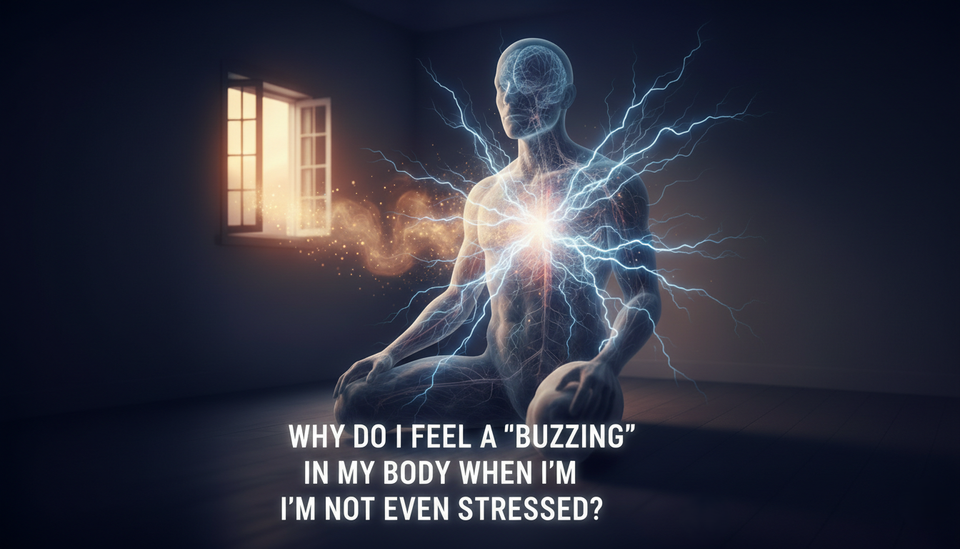
Do you ever feel a low-grade electrical hum in your chest or limbs, even when nothing "bad" is happening?
You’ve checked your coffee intake. You’ve tried to sleep more. You might even be "relaxing" on the couch, yet your nervous system feels like it’s plugged into a wall socket. You aren’t crazy, and you aren't sick. You are experiencing "Background Survival Mode."
The 10-Year Lag
Most people think stress is a reaction to today. In reality, your body is a giant storage battery for energy that never got "used." If you spent years working 20-hour days or living in high-pressure environments, your "Hardware" (your nervous system) got stuck in the ON position.
Even if your life is quiet now, the "Software" is still running the "Permanent Stress" script. This is why you feel the buzz—it’s the engine idling at 8,000 RPMs while the car is parked in the garage.
Why "Relentless Action" Makes the Buzzing Worse
When you feel this buzz, your instinct is to do more. You think, "If I just finish this project, or make this much money, the buzzing will stop." It won’t. In fact, taking "relentless action" while your body is in this state is like pouring gasoline on a fire to try and put it out. You are teaching your brain that "Safety = Effort," which only reinforces the survival loop.
The 60-Second "Smoke Window" Technique
If you want the buzzing to stop, you have to stop "fighting" it. Imagine your stress is smoke in a room.
- Don't try to fan the smoke away. (That’s more effort).
- Open the window. (Acknowledge the feeling without judgment).
- Let it drift out. The goal isn't to "fix" the feeling; it's to stop being afraid of it. When the fear of the sensation leaves, the sensation itself eventually follows.





Member discussion