Scarcity Mindset: Signs, Causes, and How to Escape It
An Important Distinction
Survival mode and scarcity mindset are often confused, but they are not the same.
Survival mode means your body and mind are acting as though existence itself is under threat. Every decision focuses on conserving energy and protecting resources.
Scarcity mindset is different. It is the belief that there is never enough — even when your basic needs are met.
Although they share many patterns, the key difference is this:
Survival mode always includes scarcity thinking. But scarcity mindset does not always feel life threatening.
What Is Scarcity Mindset?
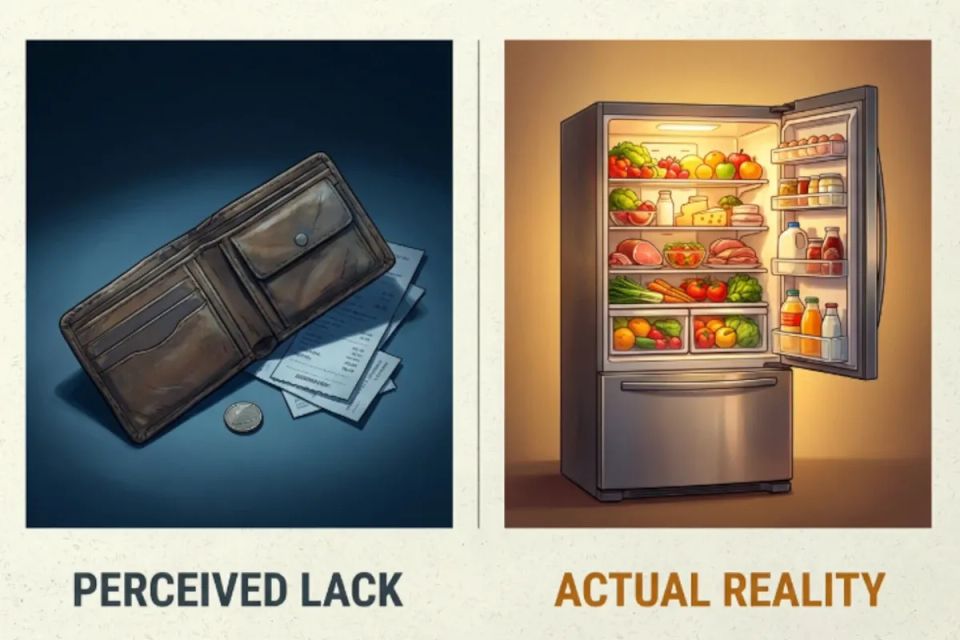
Imagine standing in front of a full fridge.
Food is there. Safety is there.
Yet your mind says — what if tomorrow it is empty?
Scarcity mindset is not about actual lack.
It is about perceived lack.
It makes you focus on what is missing rather than what is present. It shapes how you see the world, how you work, how you love, and how you treat yourself.
Signs You Are Living With Scarcity Mindset
Scarcity mindset often hides in everyday thoughts and habits. You may recognize it in yourself if:
You feel anxious about money even when the bills are paid.
You believe opportunities are limited — so you compete instead of collaborate.
You constantly compare yourself to others and feel you fall short.
You feel guilty spending on yourself even when you can afford to.
You neglect personal connections — prioritizing work over relationships, leaving little time for the people who matter.
You struggle to hold onto money. It comes in and goes out just as quickly.
You stay constantly busy — always working, always on calls — feeling you cannot afford to slow down.
You experience emotional numbness. It becomes hard to react, empathize, or fully register what others are saying.
You give surface level responses in conversations — keeping them transactional, avoiding depth. How are you? Busy. Do you need help? I am fine.
You block learning. Even helpful advice fails to sink in because your mind is conserving energy only for what feels urgent.
These signs show that your mind is locked in a cycle of fear and limitation — keeping you focused on what is missing instead of what is possible.
How Scarcity Mindset Shapes Behaviour
Scarcity thinking shows up differently depending on the person.
For some it means spending impulsively — if I don't use this money today I might lose it tomorrow. Spending becomes comfort in uncertainty. Planning feels impossible when the mind is stuck on today.
For others it means the opposite — holding everything tightly. Extreme frugality. Suspicion of generosity. The feeling that sharing or investing is simply not safe.
Both extremes come from the same belief.
There is not enough to feel secure.
At work it looks like treating every opportunity as a rare one-time chance. Competing aggressively. Avoiding collaboration out of fear that sharing will reduce your own advantage. Micromanaging. Resisting investment in tools or people even when the numbers justify it.
In families it looks like rushed interactions — as though attention itself is finite. Buying the cheapest of everything out of habit rather than necessity. Saving the best food for others while personally settling for less. Believing that your own needs matter less than everyone else's.
With money and possessions it looks like buying things today because you might not be able to afford them tomorrow. Stocking up excessively. Talking constantly about not having enough — and in doing so, reinforcing the very belief that keeps you there.
Causes of Scarcity Mindset
Scarcity mindset does not appear without reason.
It is built by experience.
Financial insecurity or debt. Constant comparison with others. Past experiences of genuine lack. Stress and uncertainty about the future. Cultural or family beliefs about money and success that were absorbed before you were old enough to question them.
Most people who carry scarcity mindset did not choose it.
They learned it. In homes where money was spoken about like an enemy. From years of watching the people they loved live as though there was never enough.
The belief was installed early. Before there were words for it. Before there was any reason to doubt it.
Which is exactly why it is so difficult to simply think your way out of it.
How to Escape Scarcity Mindset — The Honest Version
If your bills are paid. If the fridge is full. If by any external measure you have enough —
But your body still does not believe it —
Then you are not living in scarcity.
You are living in the memory of it.
At some point in your life — you were a person having financial difficulties. Or you watched someone you loved be that person. And your nervous system learned its lesson so completely, so early, so deeply —
That even after everything changed —
The belief did not.
You carried the old fear into the new life.
And it unpacked itself quietly. Without asking permission. Without announcing itself.
It simply — stayed.
What actually helps in such cases is— recognition.
Recognition that the belief you are carrying —
There is never enough
— was true once.
It was not weakness. It was not failure. It was intelligent, faithful adaptation to a real situation that required exactly that response.
Your nervous system was right — then.
But then is not now.
The work — and it is real work, slow work, patient work — is showing your nervous system, through repeated experience, that the old threat no longer exists.
Not by telling it.
Not by thinking it.
But by doing something the fear says you cannot afford to do.
Small acts of deliberate abundance.
Not grand gestures. Not reckless spending to prove you are not afraid.
Small. Deliberate. Conscious.
Buying the slightly better thing — when the old habit automatically reaches for the cheapest.
Leaving something on the plate — when the old pattern says finish everything just in case.
Resting without guilt — when everything in you says you cannot afford to slow down.
Giving something away — money, time, attention — when the fear says hold tighter.
Saying I have enough — not as an affirmation repeated in a mirror — but as a conscious choice made in a specific moment when the old voice says otherwise.
Each small act sends the same quiet message to the nervous system:
The old rules no longer apply here.
But perhaps the most powerful thing you can do —
Is not something you do alone.
The nervous system learned scarcity in relationship.
Through a home where money was spoken about like an enemy. Through years of watching the people you loved live as though there was never enough.
And it heals in relationship too.
Not in grand therapeutic breakthroughs necessarily.
But in the quiet, repeated experience of being near someone who is not afraid.
Someone whose nervous system is calm. Whose presence says — without words — that safety is possible. That enough is real. That the world is not as threatening as the old wound insists.
This is called co-regulation. And it is one of the most powerful forces for nervous system healing that exists.
Which means sometimes the most important step is not a practice or a habit or a mindset shift.
It is simply — finding the right people to be near.
People whose relationship with enough feels different from everything you were taught.
And staying close to them.
Long enough for something to change.
Because the nervous system does not update through insight.
It updates through experience.
Repeated. Patient. Gentle. Real.
Until one ordinary day —
You reach for the cheapest option out of pure habit —
And something in you pauses.
And chooses differently.
Not because you forced it.
But because somewhere along the way —
Without quite noticing when —
The body finally received the message it had been waiting a long time to believe.
It is safe now.
There is enough.
You can put the armor down.
A Final Thought
Scarcity mindset whispers — never enough.
It does not care how much you have. It does not care how hard you worked. It does not care that the fridge is full or the bills are paid or that by every external measure — you made it.
It simply keeps whispering.
Until something changes that is deeper than thought.
Deeper than habit.
Deeper than willpower.
Until the body — that faithful, frightened, impossibly patient body — finally learns what the mind has been trying to tell it for years.
There is enough.
There always was.





Member discussion