Too Good To Ignore: Why The World Eventually Has To Listen

For everyone who is giving everything — and hearing mostly reasons why it won't work.
This is for the singer who knows what their voice can do — and is still waiting for the room that agrees. For the actress who walked into the audition prepared, present, and ready — and walked out without a callback. For the writer whose manuscript sits in a drawer because the doors haven't opened yet. For the content creator who shows up every day, puts out real work, and watches the needle stay at zero.
Amidst all the confusion, the disappointment, and the real effort it takes to pay the rent and keep the lights on, even the people who care about you most may say things that add to the weight without meaning to. Things like, you have arrived too late to the party. The market is saturated. The spots are already taken.
These words come from a good place. But they may come from an incomplete picture. The people who say them were simply elsewhere when the competition was at its height — busy with their own lives, their own priorities, their own chapter of the story. They did not sit in waiting rooms thirty years ago. They did not see how many people were already there, competing for the same role, the same record deal, the same publishing contract.
Because this is what those rooms looked like back then as well— the talented, the prepared, the hopeful, lined up in the hundreds for a single opportunity. That has not changed. It was never easy. The competition has always been exactly this fierce.
And the rooms are not getting smaller. The competition is real. Maybe more crowded than ever. The gatekeepers and decision-makers don't open doors easily, and sometimes don't open them for a very long time. None of that is imagined, and nobody who has lived it would pretend otherwise.
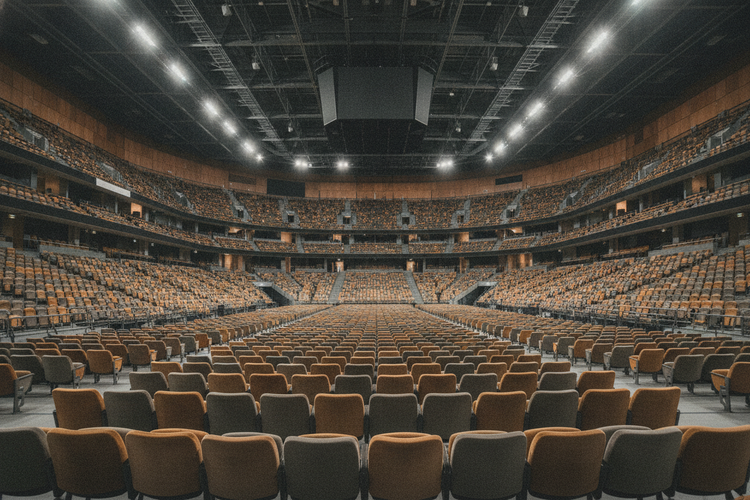
You might be a very talented singer indeed. And then you walk into an audition room, and there are two thousand people just like you —gifted, well prepared, with the exact same aspirations. That is not a failure of your talent. That is simply the size of the room. And it is a genuinely hard thing to absorb.
Some of the most celebrated names in the history of film, music, and literature were told, early on, that they were in the wrong place. That they didn't have what it takes. That someone else in the waiting room was more like what the industry was looking for. These were not small moments. They were the kind of words that stay with a person. The kind that could have ended everything — and almost did.
And in the years between the "No" and the eventual "Yes," many of them had to find other work entirely. A 'real' job. A side hustle. Something to put food on the table and keep the dream alive at the same time. Not as a footnote to their story — but as a central, largely untold part of it.
The people who told them "No" were not always wrong about the difficulty. They were just wrong about the outcome.
Why recognition takes longer than it should
It is a fair question to ask. If talent finds its way, why do the people at the top seem to remain the same? Why does the industry seem to circle the same names rather than constantly discover new ones?
Part of the answer is simply that success creates its own warmth. A name that has moved people, made them laugh, made them feel something real — that name becomes difficult to replace. Not because the industry protects it, but because the audience does. Think of the actor whose particular smirk became part of your childhood. The comedian whose laugh was so specific, so genuinely his own, that no one who came after has quite filled that space. These people didn't stay at the top because someone held the door open for them. They stayed because what they gave their audiences was irreplaceable.
And it is not only people. Think of a film made forty years ago that you still return to. Not out of nostalgia. But because something in it cannot be found anywhere else. When that writer's pen went quiet, there was a gap left that nobody has been able to replace.
What has changed — and what hasn't
The world is different now in one important way. Access to information, to tools, to the work of others — it is instant. Thirty-five years ago, finding the research you needed meant spending a full day in a library. Perhaps two. That difficulty was not just an inconvenience. It was, quietly, one of the things that made certain people exceptional. The long search. The slow digestion. The question held for days before an answer arrived. Something happened in that process that cannot quite be replicated by a search that takes three seconds.
When everything is visible and instantly available, it becomes easier to sound like someone else. To write like someone else. To make something that resembles what already exists. This is not a criticism — it is simply what happens when the distance between influence and expression collapses. We are all shaped by what we consume, and we consume more than any generation before us.
And yet. Originality has not disappeared. It has just become rarer. Which means — if you have it — you are not competing with the room you think you are in.
If what you make is genuinely yours — truly, unmistakably yours — the competition is smaller than it appears.
The thought experiment
Think of a musician whose work has genuinely moved you. Someone whose gift feels undeniable. Now imagine taking them somewhere nobody knows their name. No reputation. No history. No introduction. Just them, and what they can do.
The stadium quality voice, heard for the first time in a small room, does not need an announcement. It arrives in such contrast to everything around it that the room has no choice but to stop and listen. Not because of who it belongs to. But because of what it is. Because it is so far beyond what we are used to hearing that the air in the room changes.
That is the most honest definition of genuine talent. The thing that cannot be faked. Cannot be manufactured. Cannot be permanently hidden. Because it is not performing greatness — it simply is it. And the people in that room, whoever they are, feel the difference before they have words for it.
This is the proof that reputation is not the source of the gift. It is merely what accumulates around it, eventually, when enough rooms have been stopped in their tracks.
The honest case for continuing
This is not an argument that persistence alone is enough. It is not a promise that hard work will always be rewarded on a timeline that feels fair. The gatekeepers are real. The crowded rooms are real. The years of invisible effort — the rejection letters, the empty venues, the work that sits unseen — all of it is real, and none of it should be minimised.
But here is what is also real. Every name that the industry now treats as irreplaceable was once unknown. Every face that appears so reliably on our screens once sat in a waiting room, measuring themselves against someone else, wondering if there was any point. They had to find a way through first — and they did, not because competition was less intense, but because what they had was too specific, too genuine, too itself to be permanently ignored.
And when recognition finally came, it did not arrive as generosity. It arrived as inevitability. The doors did not open out of kindness. They opened because someone on the other side heard the voice, or read the page, or watched the performance — and understood that letting it walk out would be the mistake they would never recover from.
That is the distinction worth holding onto. The world is not the enemy of real talent. It is simply slow to recognise it. And when it finally does, lives can change for the better almost overnight.
There is plenty of talent in the world. There always has been. But there is far less of the kind that is completely, stubbornly, irreplaceably original. If you are making something that could only have come from you — shaped by your particular life, your particular way of seeing, your particular refusal to sound like anyone else — then you are not one of two thousand.
You are something the room has not quite seen before. And rooms, eventually, notice that.
Real talent paired with persistence cannot be ignored forever. Not because the world is always fair. But because a stadium quality voice, heard for the first time, stops the room — whoever is in it, wherever it is. And a room that has been stopped cannot pretend it wasn't.
Further reading: Wait" and "Too Late" — Two Lies That Sound Like Wisdom.




Member discussion